

News
25.06.2026
“What Ukraine Needs Now” - Victor Pinchuk Foundation host YES Dinner Discussion on the eve of the URC in Gdańsk
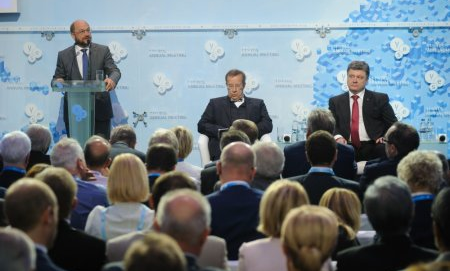
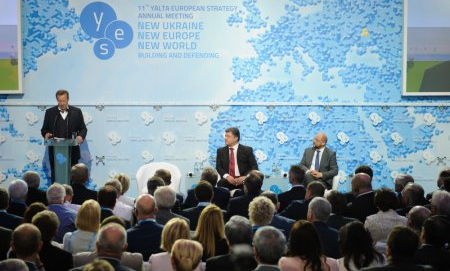
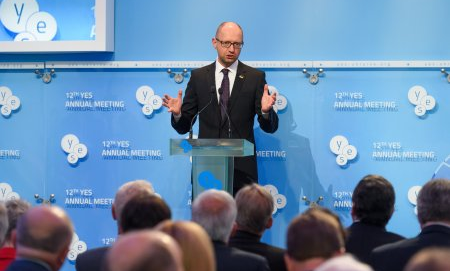
On June 24, 2026, on the eve of the Ukraine Recovery Conference (URC) in Gdańsk, the Victor Pinchuk Foundation and Yalta European Strategy (YES) hosted the traditional YES Dinner Discussion, gathering international leaders, policymakers, business executives, experts, and representatives of civil society.
This year’s discussion focused on the topic: What Ukraine Needs Now. While Western allies have overcome their initial delays in providing aid to Ukraine, and Poland has offered indispensable logistical and humanitarian support to millions of Ukrainians, the baseline of support remains operationally insufficient to bring Russia’s aggression to an end. Ukraine acknowledges the profound humanity and unprecedented generosity of its partners, and demands an immediate escalation in sanctions, weapons, and defense technology investments. Victory is the strict prerequisite for peace; if we fail to fund the lethality of the present, there will be no future left to rebuild.
Opening the event Victor Pinchuk, businessman and philanthropist, founder of YES, said: “Ukraine can win. But for that we need your help. And your help means more sanctions, more weapons support, and much more investment in our military tech. This is the best investment in our victory, peace, reconstruction, and a beautiful recovery.”
Speaking about Poland’s solidarity with Ukraine, Victor Pinchuk also stressed: “I love Poland. Ukrainian people love Polish people. Polish people love Ukrainian people. If you love, sometimes you fight. But because of your love, it’s easy for you to overcome. And we have to remember this. “
Kristen Michal, Prime Minister of Estonia, stressed the importance of Ukraine becoming a NATO member: “We should have a conversation about Ukraine being a NATO member. Because we have the best fighting army in Europe. Where else should it be other than in NATO?”
“In Russia, everything is getting gloomy. This is not anymore a three-day special operation, it has entered its fifth year. They have long-range strikes on metropolises, they have 5G switched off, they have Telegram closed, and a dictator, who is paranoid. On the other hand, there is Ukraine, that has the backing of Europe and allies.”
Marta Kos, Commissioner for Enlargement, announced that on 25 June the EU would allocate the first 3.2bn euros of a 90bn-loan for Ukraine: “Europe can deliver, and we are delivering.”
She also commented on the opening of the first accession negotiation cluster between EU and Ukraine: “No enlargement process can capture what a country is already contributing to Europe. There is no chapter for bravery. We have no chapter for courage. We have no chapter for resilience to express what Ukrainian people are already doing for us Europeans. That’s why it is a two-way street. And with the opening of the first cluster, there is no doubt that Ukraine belongs to Europe.”
“We cannot be safe in Europe unless Ukraine becomes a EU member,” Marta Kos concluded.
Taras Kachka, Deputy Prime Minister for European and Euro-Atlantic Integration of Ukraine, shared Ukraine’s progress in anti-graft prosecution: “Between 1 January 2025 and 31 May 2026, NABU (The National Anti-Corruption Bureau of Ukraine) has opened 1038 cases, SAPO (Special Anti-Corruption Prosecutor’s Office) has issued 309 new suspicions in 175 indictments regarding 377 individuals, the High Anti-Corruption court issued 140 sentences against 190 persons, who were involved in corruption.”
“We are very serious on the defence line, in defence industry and about our reforms. And now we need to have the same seriousness on the EU’s side,” he added.
Jeremy Lewin, US Under Secretary for Foreign Assistance, Humanitarian Affairs, and Religious Freedom, commented on US’s role as a mediator in peace talks between Russia and Ukraine: “If Europe’s perspective is that it shouldn’t take on a mediator’s role, the US has to take on that role. Because who else can help mediate between Russia and Ukraine? All of us believe that the end of this war, what’s best for Ukraine and its people, has to be a durable and just peace, but a peace.”
Andrzej Domański, Minister of Finance and Economy of the Republic of Poland, touched upon the cost of war: “Peace is not only a diplomatic achievement, but also an economic structure that makes war less rational. Ukraine today is resisting a brutal aggressor not only thanks to the resilience and courage of its Armed Forces and citizens, but also thanks to sustained support of the international community.”
Carl Bildt, Minister for Foreign Affairs of Sweden (2006–2014); Prime Minister of Sweden (1991–1994); Co-Chair of ECFR; Member of the YES Board; moderator of the discussion, commented on Ukraine’s economic potential: “If you look at the long-term potential of Ukraine, it is clearly to be another Poland in terms of the economic development. In certain areas, Ukraine has even better potential, than Poland had.”
Chrystia Freeland, Former Deputy Prime Minister & Minister of Finance of Canada, said: “Today, Ukraine is not an object, but Ukraine is a subject. Ukraine has main character energy. What we hear from Europeans, Ukraine is transforming Europe in a positive way. Ukraine has shown it can defend itself. By doing that Ukraine has shown Europe: ‘You guys, can defend yourselves’.”
Philipp Michael Hildebrand, Vice Chairman of BlackRock, outlined the key conditions needed to mobilise private capital for Ukraine’s long-term reconstruction and economic success: “As we all try to build this reconstruction path, we have to think about how do we get private capital in the end to sustain a long-term economic framework around reconstruction and beyond. And private capital will only come if three conditions are in place: a credible European perspective, a pathway toward peace or at least stability, and strong public investment to catalyse private financing.”
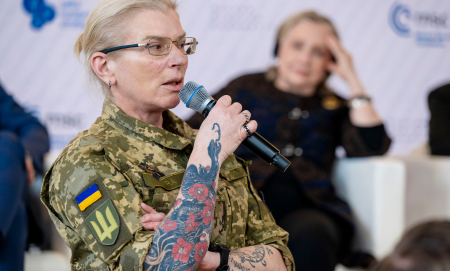
Brittney Shki-Giizis, UAV crew commander, Ukrainian Armed Forces, shared her experience as a soldier serving in the Ukrainian army and stressed how the nature of war has changed: “War has changed in tactics and in technology. And what I've seen from the West, from NATO armies, is complacency, almost a refusal to acknowledge just how dramatic the change is on the front.
Try to imagine the density of drones on the frontline, and how impossible it is just to move even 4 km. I’ve seen NATO’s training videos, where they have tanks, armoured vehicles and infantry walking across open fields, and all I can think of is how many casualties they are going to take with this tactics. They are not taking this seriously.”
She also stressed on the importance of the international partner's support: “I came today with anger in my heart and exhaustion in my soul because we feel like on the ground that we are not being heard, we are not being supported. And I understand that's not correct because the support has been incredible, but we need more.
And it's okay to plan for the future, but that's not going to help us if there is no future.”
Maksym Kolesnikov, veteran and former PoW, psychologist, Chief marketing officer at the Ukrainian defense tech company TAF Industries, called for more support to Ukraine: “If you help us, we’ll win faster. And there will be fewer homes to rebuild. Thank you for you support, but we need more. And we are ready to be a partner, because we have some technology, that you don’t have.”
Radosław Sikorski, Deputy Prime Minister and Minister of Foreign Affairs of the Republic of Poland, shared his view on the historical principles behind enduring and lasting peace with respect to recent downturn in Ukrainian-Polish relations: “The history between our countries is much richer than one genocidal ethnic cleansing. So if Ukraine is to become a EU member –and Poland is still be in favour – we will negotiate, but we’ll be in favour , we need to have this at the back of our minds: The European Union is at its core a peace process, it’s about preventing the nightmares of the past ever recurring.”
Oleksandr Korniyenko, First Deputy Chairman of the Verkhovna Rada of Ukraine, said: “It’s our duty to fight for democracy in these battles between each other, despite obstacles, and to provide financial guarantees to our army. All budgetary issues are promoted in a stable way.”
Oleksandr Kamyshyn, Advisor to the President of Ukraine on strategic issues, said: “I'm happy that people on the stage, people in the room, speak about the defence industry as about something that is critical and something that is significant. I am sure that we will build up with Poland, with Europe, a stronger defense industry framework. We will do it and we'll make Europe strong again.”
In closing remarks, Aleksander Kwaśniewski, President of the Republic of Poland (1995-2005); Chairman of the YES Board, expressed hope for some kind of a ceasefire in the near future: “I think that something will happen in the coming months. This will not be peace. Because I don’t believe that as long as Putin, or even Putin’s successor, is a leader of Russia, this country will think and will be interested in real peace. And absolutely not in just peace. But I think that we are close to some kind of a ceasefire.”
He also stressed that Ukraine should become NATO’s member as Europe’s largest battle-tested army: “One million Ukrainian soldiers could be a really strong asset for our capacity to answer to all these fears coming from the Russian side. But if NATO is not part of security guarantees (for Ukraine), then there is EU membership. And this is something that is possible, and I believe, will happen soon.”
Since 2023, on the eve of each Ukraine Recovery Conference, the Victor Pinchuk Foundation has hosted YES Dinner Discussions. International and Ukrainian leaders debate candidly how to make support for Ukraine even more effective: to end the war, create security for Ukraine and Europe, and enable Ukraine’s innovative economy and powerful society to surge.
Photos are available here
Video is available here