

News
23.01.2026
Summary of the 4th Day of discussions at the ‘Ukraine: Future’s Frontline’ project, held in Davos on the occasion of WEF 2026
On the occasion of the World Economic Forum Annual Meeting 2026 in Davos, the Victor Pinchuk Foundation hosted a series of high-level panel discussions as part of the ‘Ukraine: Future’s Frontline’ project.
The events brought together leading global and Ukrainian figures to discuss how our future security, prosperity and global position are being shaped in Ukraine.
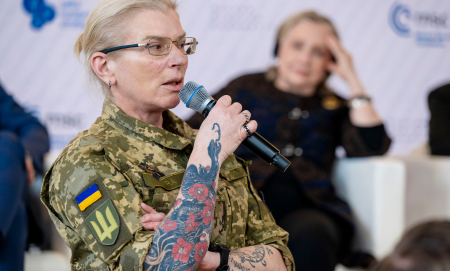
In an emotional panel titled: ‘Insights from Russian Captivity – Cruelness as a Strategy’, speakers from the military, human rights organisations, medics and international media came together to discuss Russia’s strategy of crushing resistance by deploying extraordinary cruelty, and can we learn about the reality of Russia from those who returned from Russian captivity?
Katrin Eigendorf, Journalist, ZDF, moderated the panel. She started the panel with the statement: “Peace doesn’t mean making concessions to the aggressor, it means protecting them from their cruelty. Cruelty as a means of war, cruelty as a culture of aggression. There is an estimated number of 25k Ukrainians that has in still are in captivity.”
Ivan Nakonechnyi, Marine, Commander of Reconnaissance Squad, Military Unit A2777: “I spent 3 years and 5 months in Russian Captivity. We cannot call them people or that they are observing Genea convention. It didn’t become easier. They told us if we said something wrong, we would suffer. We didn’t have a choice as we had to preserve our health to help us continue.”
“They had to preserve our health and we Ukrainian love our freedom. I was worried about my family and my country. My brothers in arms clung together,” Nakonechnyi added.
Olga Bondarenko, PoW, an officer in the Support Unit for former POWs at the National Guard of Ukraine’s Center for Operational Psychological Support: “Russia is a totally dishonest nation – they do not confirm the numbers. They attack our people physically and mentally, as well as their families. It is extremely important to return. Psychological trauma is very hard to recover from. It is about restoring trust and bringing self-awareness of where they are in the world. We work with them and with their families. Integrating and becoming stronger is a challenge.”
Bondarenko said: “It will preclude us from having a normal life. There are civilians in captivity and some of them have been tortured to death. We don’t have the numbers. Civilians in captivity have no Geneva convention.”
Oleksii Anulia, PoW, Veteran: “I stay to stay in hospital for a year and 9 months. My jaw broken, eye suffered, muscles were tearing from the bones, broken bones, kneecaps broken, nails torn away, teeth were broken as I was no disciplined. They do everything to break people mentally, morally and physically.”
“You cannot imagine what it is like to stay there. The torturers have children, and they will pick this up and continue,” he concluded.
Kyrylo Berkal, Deputy Commander of the Third Army Corps: “We observe that Russia treats their own people like animals, just like they treat the enemy. We talk at Davos about peace but the machine that produces the beast is still there. The only answer to stop this is by the strength of the free humans, by democracy.”
“We choose to fight. There is only way to return our men is by the power of Ukrainian nation. We have to remember our spirit by 2022. We need to be strong; people support the strong. We need to strong this aggression and break the regime. There is only one option – change or die. That is all,” said Berkal
Oleksandra Matviychuk, Head of the Center for Civil Liberties: “I have been documented war crimes for 12 years already. From February 2014, not 2022. After 12 years we don’t know complete number of people in prison or died in captivity. It is more than 12,000.”
“We have stories of people whose nails pulled out or drilled, they were electrocuted and a lady had her eye pulled out with a spoon. I spoke to a young girl 5-7 years old. Her mother kidnapped, she was tortured and was gang raped – I don’t know how she survived. When I met the daughter – she asked me to please return her mum. I am a professional lawyer but I don’t have the tools to return her mum. It broke me,” she said visibly moved.
The project ‘Ukraine: Futures’ Frontline’ takes place on 19-22 January, 2026, on the occasion of #WEF2026 in Davos as part of a broader series of Ukrainian events designed to amplify Ukraine’s voice, highlight its resilience, and foster a dialogue on the future of the country and global security.
The project includes an exhibition and a three-day discussion program focused on Ukraine as a testing ground for the future of security, innovation, and reconstruction.
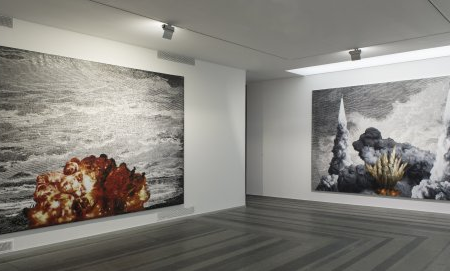
As part of the exhibition, works by Ukrainian artists Oleksii Sai, Yarema Malashchuk, and Roman Khimei will be presented, alongside Damien Hirst’s The Incomplete Truth. The exhibition addresses the risk of war spreading to Europe while stressing the need for peace through strength. A portrait of Ukraine at the frontline of innovation as well as the best line of defence for Europe’s future.
‘Ukraine: Future’s Frontline’ is a platform exploring our future security, prosperity and global position. Our future is shaped in Ukraine: Ukrainians defend their sovereignty and Europe’s security. And in this fight, Ukraine must be at the cutting edge of innovation. Of the competition that will determine tomorrow’s world. Ukrainians develop cutting edge drone technology, AI, and redefine standards for military and civilian technologies.
More information about the project “Ukraine: Future’s Frontline” is available at www.ukraineindavos.org
Photos are available here
Video will be available here www.youtube.com/user/PinchukFoundation/