

News
22.01.2026
The Victor Pinchuk Foundation hosts the traditional Ukrainian Breakfast Discussion on the occasion of WEF in Davos
Special guest of the Ukrainian Breakfast Discussion was Steve Witkoff, US Special Envoy to the Middle East and US negotiator on the Ukraine peace process, who joined the discussion at the invitation of Victor Pinchuk.
On 22 January, in Davos (Switzerland), the Victor Pinchuk Foundation hosted the Ukrainian Breakfast Discussion, a traditional private event organized on the occasion of the World Economic Forum (WEF).
The discussion explored scenarios for the future of Ukraine and ways to force Russia to peace.
Among the speakers of the discussion were Mark Rutte, Secretary-General, NATO; Alexander Stubb, President of the Republic of Finland; Edgars Rinkēvičs, President of Latvia; Dick Schoof, Prime Minister of the Netherlands; Bart De Wever, Prime Minister of the Kingdom of Belgium; Andrej Plenković, Prime Minister of the Republic of Croatia; Taras Kachka, Deputy Prime Minister for European and Euro-Atlantic Integration of Ukraine; Larry Fink, Blackrock CEO, Co-Chairman of the World Economic Forum. The discussion was moderated by Fareed Zakaria, Host and Bestselling Author at CNN, and Zanny Minton Beddoes, Editor-in-Chief at The Economist.
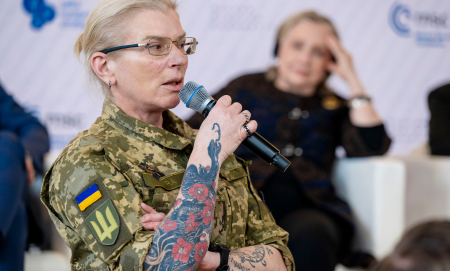
The following attendees contributed to the discussion: Steve Witkoff, US Special Envoy to the Middle East, US negotiator on Ukraine peace process; Jonathan Powell, National Security Advisor to the Prime Minister of the United Kingdom; Eric Schmidt, Former CEO and Chairman, Google; Chair and CEO, Relativity Space; Jens Stoltenberg, Minister of Finance of the Kingdom of Norway; Niall Ferguson, Senior Fellow, Hoover Institution, Stanford University; Radosław Sikorski, Deputy Prime Minister and Minister of Foreign Affairs of the Republic of Poland; Yuriy Filatov, 3rd Army Corps, Unmanned Aerial Vehicle Commander; Oleksii Anulia, PoW, veteran, active public advocate for PoWs.
In his opening speech, Ukrainian businessman and philanthropist Victor Pinchuk said: “Millions of Ukrainians share the same dream - they want just and secure peace. But unfortunately, our enemy doesn’t want peace. So we must get them (Russia) to end the war and make peace. And to get there we need to crush their hope for winning.”
Larry Fink, Blackrock CEO, Co-Chairman of the World Economic Forum, commented on the importance of foreign investment for Ukraine’s future prosperity. “Ukraine’s future will depend on whether it can establish strong governance, absolute transparency and reform framework needed to attract long-term investment and capital, and integrate itself more deeply into the European and global capital markets.”
“The private capital will be there alongside. It is our genuine desire to make sure that capital is put into the ground as soon as possible, that each and every Ukrainian citizen can see the renewal, the reconstruction. And that they can see a pathway towards stable and predictable stability and freedom,” he concluded.
Mark Rutte, Secretary-General, NATO, warned against diverging attention from Ukraine amid Russia’s increased attacks on the Ukrainian energy infrastructure in winter. “What we need is to keep the eyes on the ball of Ukraine. Let’s not drop that ball. And this means that yes, peace talks are great and fantastic, and we’ll do everything to conclude them successfully. But that will not happen tomorrow. And meanwhile, they (Ukrainians) need interceptors and military support tomorrow. So, my European and Canadian friends, we have to stay focused.”
Alexander Stubb, President of the Republic of Finland, echoed this view and called into question Russia’s willingness to agree to the peace plan being currently developed with the US involvement. “I’m not convinced that Russia will approve this (peace plan). This is the worry that I have, and that’s why I fully agree with Mark (Rutte) that this is not over. Right now, we need to focus on the today and the near future, and how we can provide for and help Ukraine,” he said.
“The big dilemma that we are facing right now is how to force Russia end this war. And there are only two things that we can do. The first one is to continue to provide Ukraine with everything it possibly needs. And the second one is to put more economic pressure on Russia. And then we will see that Ukraine will have won this war at the end of the day,” he added.
“Putin has failed in every and each of his strategic goals,” Stubb stated.
Jonathan Powell, National Security Advisor to the Prime Minister of the United Kingdom, also backed this idea and called for more pressure on Russia: “I think what we have to do is to apply pressure on President Putin - financial and military pressure, and have a deadline when he has to make a decision. I think this is the only thing that will work.”
Jens Stoltenberg, Minister of Finance of the Kingdom of Norway, said: “I don’t think that we can change Putin’s mind. His aim and his ambition are to control Ukraine, and there is no doubt about that. But I think that we can change Putin’s calculus. If the price he has to pay for controlling Ukraine is too high, then he will be forced to sit down and negotiate something that is acceptable for Ukraine.”
Niall Ferguson, Senior Fellow, Hoover Institution, Stanford University, said: “Nothing will change Putin’s calculus more decisively than a meaningful increase in the pace of European rearmament.”
“Ukraine has become the defence force of the European Union. But where are the defence forces of real EU member-states?” he wondered.
Edgars Rinkēvičs, President of Latvia, commented on Ukraine’s prospect of EU membership. “If Ukraine enters the European Union, I do believe that it is also going to make European defence identity much, much stronger,” he said. “Let’s not forget that Ukraine in the EU makes the EU much stronger from security and defence point of view with the largest combat army in Europe,” he added.
Dick Schoof, Prime Minister of the Netherlands, also shared his assessment of the timeline for Ukraine’s accession to the EU: “If we look at the way we are dealing with it now, it’ll take a couple of years. We have to be honest about it. Because we don’t want to destabilize the European Union with a state that come in to fast.”
Taras Kachka, Deputy Prime Minister for European and Euro-Atlantic Integration of Ukraine, said: “We also want predictability, security guarantees, financial support and predictability in the timeframe of EU accession. So we need to agree that we consent to a merit-based approach to EU accession, but we want your commitment to accept us by a certain date.”
Steve Witkoff, US Special Envoy to the Middle East, US negotiator on Ukraine peace process, shared updates on the progress in peace negotiations: “I think that we have made a lot of progress.”
“We spent the whole dinner last night talking about the upward trajectory for the Ukrainian economy and financial system - capital markets, the jobs… The President (Trump) talked about a tariff-free zone for Ukraine, that I think will be game changing, and you’ll see the industry moving into that area,” he added.
Radosław Sikorski, Deputy Prime Minister and Minister of Foreign Affairs of the Republic of Poland, said: “If Ukraine doesn’t end up with defensible borders as a result of the deal that I hope comes, we will be planting the seeds of the next war. To get to a fair deal, you have to put pressure not only on the victim of the aggression, but on the aggressor.”
He also mentioned Russia’s increased attacks on civilian infrastructure in Ukraine: “Deliberately targeting civilian infrastructure is a war crime. Vladimir Putin is no man of peace.”
Andrej Plenković, Prime Minister of the Republic of Croatia, said: “We are fully aware of the suffering of the Ukrainian people. Our energy companies cooperate with Ukrainian ones, and we are currently providing necessary equipment that was destroyed. So we want to help you to get through this suffering during the winter.”
Bart De Wever, Prime Minister of the Kingdom of Belgium, shared his stance on the situation with Russian frozen assets in Europe: “When there is a peace deal, the assets will be on the table. And let me be very clear about that - at that moment, if I have a say on this, every penny of that money will be used for repaying and rebuilding Ukraine. I would be very sad to see one euro being returned to Moscow. But we have to respect international law.”
“It’s Europe’s obligation to finance Ukraine, and we did,” he added.
Eric Schmidt, Former CEO and Chairman, Google; Chair and CEO, Relativity Space, commented on innovation on the battlefield: “The war is going to completely reverse. The way you do war, and the way you do national security will start with robots in the form of drones in the air, on the land and at the sea. It’s my absolute conviction that when this war is over, Ukraine will become one of the largest suppliers of this new form of war and new form of defence.”
Yuriy Filatov, 3rd Army Corps, Unmanned Aerial Vehicle Commander, said: “It’s time to accept the reality. International law is not working any more. Strength is the only thing that these neo-empires could actually understand. Unfortunately, I don’t really believe in deals, because deals are rational, and our enemy is not. So, please, accept this.”
“Europe should unite and be strong. Because only that matters to Putin’s neo-empire,” he said.
Oleksii Anulia, PoW, veteran, active public advocate for PoWs, called on European partners for more decisive steps to put an end to Russia’s aggression: “If each of your individual decisions is more specific and swifter, if it brings about peace and security to Ukraine, and then I'll be able to explain to my children that our path is not about pain, but about purpose.”
Photos are available here
Video will be available here www.youtube.com/user/PinchukFoundation/