

News
19.11.2025
The seventh mental health center of the nationwide RETURNING network has opened in Lutsk.
The seventh mental health center of the RETURNING (ukr. ПОВЕРНЕННЯ) network — founded by Victor and Olena Pinchuk to support Ukraine’s Security and Defense Forces — has begun operating in Lutsk. Each year, four thousand service members, veterans, and their family members will be able to receive high-quality, comprehensive, and free psychological support here.
The RETURNING project demonstrates a successful example of partnership between the private sector and the state, in which philanthropists establish mental health centers on the basis of public medical institutions. The new branch of the network will operate on the basis of one of Volyn’s key healthcare facilities.
With funding from the RETURNING project, part of the first floor was renovated and equipped as a modern, comfortable, and fully inclusive center that meets global accessibility standards: wide doorways, no thresholds, medical non-slip linoleum, and inclusive restrooms, including those suitable for wheelchair users.
The center houses five specialist offices, a group-therapy room, a two-bed day-care ward with electric multifunctional beds and an inclusive bathroom with a shower, as well as a procedure room, a staff room, a staff rest room, a reception area with a waiting zone, inclusive restrooms for visitors, and a storage room.
The center is equipped with everything needed for therapy and trauma work, including a Shiftwave System (USA) for psychological relaxation and stress management; materials for art therapy; metaphorical associative cards; board and psychological games; anti-stress tools; tactile mats; massage balls; yoga mats; and other therapeutic equipment. The center’s specialists also have access to a professional literature library and equipment for effective work: two computer sets, multifunctional devices, a multimedia projector and screen, and four laptops.
As in other branches of the RETURNING network, a multidisciplinary team works with visitors at the Lutsk center. It includes psychiatrists, psychologists, psychotherapists, and nurses, and — when needed — case managers, social workers, and veteran-support specialists. They accompany a person at every stage — from initial consultation to long-term therapy and psychological recovery.
“When we develop the nationwide RETURNING network, we start not with the walls but with the teams. The best specialists are the heart of every center. They create the atmosphere of safety, trust, and psychological inclusivity where service members and veterans can speak about the hardest things and receive support that truly works. It is fundamentally important for us that help is close by. That’s why we open centers across Ukraine — so everyone who needs support can access professional services near home, in their own city,” says Svitlana Hrytsenko, head of the RETURNING project.
Psychological inclusivity is embedded in the foundation of all RETURNING centers. This means that the space, communication, and therapeutic approaches are designed so that every visitor — regardless of experience, condition, or trauma — feels safe, respected, accepted, and able to speak about the most difficult things without fear of being misunderstood or judged. In Lutsk, this philosophy is reinforced by a peer-to-peer approach and a team of specialists with deep understanding of wartime realities.
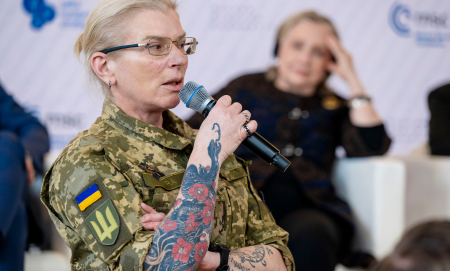
Particular attention is devoted to safety and trust. The center director, Olha Ostapchuk, has three years of combat experience with the 100th Separate Mechanized Brigade, where she served as head of the medical service. She was demobilized in March 2025 and is a retired major of the medical service.
“For everyone who comes to our center, we develop an individual recovery plan. Some need more work with anxiety; others — with traumatic memories or adaptation to civilian life. What matters is that a person feels they are not going through this alone — we move with them step by step. We work comprehensively — from stabilization and psychotherapy to medication support, group sessions, and daily assistance from the multidisciplinary team. And, of course, we create a safe space where one can speak openly, without fear of being misunderstood,” says Olha Ostapchuk, director of the RETURNING center in Lutsk.
The RETURNING mental health center in Lutsk will provide service members, veterans, and their families with effective psychological assistance — including cognitive-behavioral therapy, gestalt therapy, trauma-focused psychotherapy, stabilization and self-regulation techniques, group therapy, and crisis counseling. Specialists work with individuals who have PTSD, anxiety and depressive disorders, adaptation difficulties, psychosomatic symptoms, and other consequences of psychological trauma.
Today, centers of the RETURNING network are already operating in Dnipro, Ternopil, Poltava, Kropyvnytskyi, Lutsk, Rivne, and Khmelnytskyi. In the first stage of the RETURNING project, it is planned to open 20–25 mental health centers across Ukraine. Each year, more than 100,000 service members, veterans, and their families will be able to receive professional psychological support — restoring strength, balance, and confidence.