

News
23.01.2025
Victor Pinchuk Foundation and EastOne Hosted Davos Ukrainian Breakfast 2025
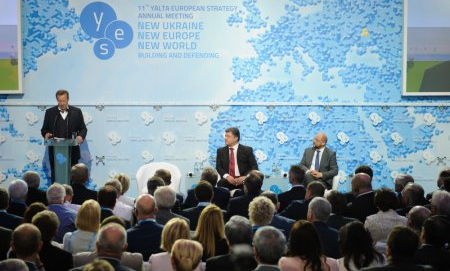
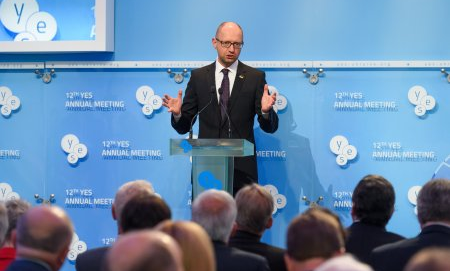
On January 23, 2025 in Davos (Switzerland), the Victor Pinchuk Foundation and EastOne, hosted the annual Ukrainian Breakfast discussion, their traditional event, which takes place on the occasion of the Annual Meeting of the World Economic Forum (WEF). The discussion offered an urgent perspective on the shifts reshaping the global order and highlighted Ukraine’s crucial role at this pivotal moment.
The discussion panel included: Victor Pinchuk, Founder of EastOne and Victor Pinchuk Foundation; Mark Rutte, NATO Secretary-General; Andrzej Duda, President of the Republic of Poland; Edgars Rinkevics, President of the Republic of Latvia; Alexander Stubb, President of the Republic of Finland; Alexander De Croo, Prime Minister of the Kingdom of Belgium, and Andrej Plenković, The Prime Minister of the Republic of Croatia.
The panel was also joined by three members of the new US administration (online), each making their first public appearance since the inauguration, in support of Ukraine: Ambassador Richard Grenell, Presidential envoy for special missions; Senator Joni Ernst and US Congressman Mike Lawler.
Fareed Zakaria, host of Fareed Zakaria GPS on CNN, moderated the discussion.
Victor Pinchuk welcomed guests to the 20th Annual Ukrainian Breakfast, introducing the title of this year's project ‘YOUR COUNTRY FIRST - WIN WITH US’, and explaining that it is not meant to be isolationist, but rather to demonstrate that all leaders must put interests of their countries first, and that if they do, it follows that they must support Ukraine. He said: “If someone says, "The interest of my country first," this means that this person, this leader must support Ukraine. Because if the interest of your country comes first, this means that national security is vital for you. It means you cannot allow our crazy, terrible enemy to win in Ukraine. If this enemy wins in Ukraine, which definitely will never happen, it will damage, severely damage the national interest of your countries. It means you understand how vitally important Ukraine is for the interest of your countries. Let's shape our message during our Ukrainian Breakfast together. Your country first – win with Ukrainians.”
He continued: “We have the founder of the WEF at Davos here, Professor Klaus Schwab. He has supported our Ukrainian Breakfast (used to be lunch) since 2005, this is our 20th anniversary. It is a great honour that he has chosen to be here, imagine how many other breakfasts are happening today in Davos.”
Professor Klaus Schwab, founder of the World Economic Forum at Davos, said: “After listening to Victor Pinchuk I think I should create a new slogan, “Ukraine first, Europe first, US first, Ukraine first”. It’s been nearly three years since the full-scale invasion of Ukraine by Russia, 1000s of lives have been lost and millions have been displaced. It is devastating for someone who was born before WWII, and who has experienced the losses of war. We have condemned the Russian aggression, and we have created a platform for Ukraine, which we will maintain for as long as it is necessary. I’m pleased, particularly today, to have such a strong delegation from Ukraine. President Zelenskyy’s participation this week was so important, it was a milestone.”
Mark Rutte, NATO Secretary-General, commented: “We have to step up and not scale back. We know the frontline is going in the wrong direction. This is not only a European conflict, it is a geopolitical conflict. There is a commitment that Ukraine will enter NATO. We just need to work out when. We must be clear with Vladimir Vladimirovich Putin that he has no input, no vote on who can join NATO. Only if he wants to join. Otherwise, he has nothing to say about it.”
He continued, “We can never again have the situation we had with Minsk, it must be a sustainable peace, we have to make sure that Putin will never, ever, ever try again to get a square inch of Ukraine.
“My problem is that I see too many politicians inside Ukraine and outside Ukraine, contemplating, aloud, what might happen. The risk is that we are negotiating with Putin without Putin at the table. Putin is sitting in his reclining chair ticking our options off his check-list. We need Ukraine in the best possible situation for when peace talks start. We need to make sure that whatever the outcome is, it is sustainable.”
Ambassador Richard Grenell, Presidential envoy for special missions, speaking from Los Angeles, said: “Trump is clear about wanting to solve these problems. I think there are frustrations about more talk on more spending and more war. Biden and Putin have not spoken in more than three and a half years, which is outrageous. We should be able to have conversations to solve problems. Americans find it frustrating that hundreds of millions of dollars have been spent on war, without having talks. We think that it's immoral to not try to stop wars that we are being told are absolutely inevitable.
“I would add another thing, you're going to run into a big buzzsaw in America if we have the NATO Secretary General talking about adding Ukraine to NATO. The American people are the ones paying for the defense. You cannot ask the American people to expand the umbrella of NATO when the current members aren't paying their fair share, and that includes the Dutch, who need to step up. “
Mark Rutte, answering Richard Grenell’s point, said: “The problem is not the US, it is Europe. Trump has consistently said that Europe is underspending on defense. NATO is not going to be able to defend itself if it sticks to the 2% in four or five years. I can guarantee you that 2% is not nearly enough. We need to increase spending, and we need to ramp up industry production. China is out-producing us, and they are not producing the crap they produced 20 years ago. Russia produces more in three months than we and our allies, including the US, produce in a year.”
Senator Joni Ernst stated: “What I have heard from leaders across the globe is, “Where is America’s leadership?” We now have a President that is willing to engage and have tough conversations. Trump is willing to engage whether it is taxes, tariffs or additional sanctions. He does want to end the loss of life. We need everyone to engage in this, I believe in America first, but not America alone.”
In response to the question whether the US would sign-off further military aid to Ukraine if Putin does not come to the table, Senator Joni Ernst said, “I think that is on the table. We want to see Putin back in his box, we want to see a Ukrainian victory.”
US Congressman Mike Lawler, also joining from Washington DC, made the point: “We are in the most precarious place since the lead up to WWII. Obviously, the unholy alliance between Russia, Iran, China and North Korea has created a tinderbox around the world. The President is right to seek to engage Russia and China on these issues, but there need to be concrete steps taken. We need to stand together to push back against these malign influences undermining the free world.”
Andrzej Duda, President of the Republic of Poland: “Putin and his advisors still say that Central and Eastern Europe is their zone of influence, that it is Russia’s right to have these countries in its orbit. The question is what do we do to guarantee Ukrainian sovereignty and make sure that international law is respected by Russians? We need to come up with such a strong measure that we force Putin to sit at the table. I don’t want to beg Putin to sit at the table, he must beg us, Ukraine and its allies, to sit at the table.”
Edgars Rinkevics, President of the Republic of Latvia, commented: “Of course the Baltics States are fearful. We have heard of the reestablishment of the Russia Empire, Poland, the Baltic States, even Finland they are talking about. We have two things we need to do: one, I hope the US administration will be successful in ending the war, but we must also make sure Russia does not regroup and does not regain economic power. Two, this is a moment of truth for Europe. My own country is currently at 3.4% of defense spending. We’re now discussing increasing to 4-5%. Not only because of President Trump's statement, but because we understand that Russia isn’t going to stop. It will simply use the time and then either restart the war in Ukraine or challenge other of its neighbours.”
Alexander De Croo, Prime Minister of the Kingdom of Belgium, stated: “Who is the enemy? Putin. The enemy is outside not inside. Finger pointing is not helpful. Ukraine needs to be strengthened. We are in for the long haul, our analysis shows that the Russian economy can sustain for at least a year. How do we sustain peace and how do we make sure that Russia is not a threat to Ukraine or the rest of Europe? My analysis is that we go for long term sanctions. What we hear now is negotiations are around the corner. Really? I don’t think so. Let’s first strengthen Ukraine.”
Andrej Plenković, The Prime Minister of the Republic of Croatia, stated: “We have seen the increased influence of Russia in democratic processes across Europe. We have to ask, are we going to stick to the main principles of international order as we have known over the last 80+ years? The respect of one's sovereignty, territorial integrity, respect for our neighbor’s existence? Putin has been isolated now for 10 or 11 years. There are fewer than five leaders in the West who have some sort of real personal contact with him. And that matters. That means that there is no trust. I see their narrative, they are back to calling Ukrainians small Russians as in the first year of aggression. That is very dangerous. We should, with all due respect to the impulse of the Trump administration, be careful not to fall into a trap. We must not be naïve. We must strengthen Ukraine as much as possible, stick to our principles, not accept any deal that will petrify occupied territories into frozen conflict.”
Yuliia Svyrydenko, First Deputy Prime Minister and Minister of Economy of Ukraine, stated: “We see here in Davos that businesses are ready to invest with very concrete security guarantees. NATO is the best and most obvious solution, because of infrastructure. Our economy is doing better than Russia’s, But we need investment to come. I would like to take this opportunity to say to businesses that you have as much power as the politicians. Tell them what kind of security guarantees you need to safeguard your investments. We have made 200 reforms and are doing much better on the corruption index, we will continue to keep fighting, keep working and keep reforming.
Alexander Stubb, President of the Republic of Finland, commented: “It is a no-brainer ‘Finland first. Ukraine first’. We have a 1340 km border with Russia, and a similar experience in the Winter War. That's why we are the fifth biggest supporter of Ukraine and will continue to be so in the future.
“Quite often, Americans, Europeans and Ukrainians are accused of not having a strategy for victory. I disagree with that. I actually think we have a clear plan. Number 1, in the short-term, continue military and financial support for Ukraine, and I’m encouraged by what I hear from Trump and in our discussion today, 2, in the medium term we need to strengthen Ukraine so it goes into negotiations from a position of strength. We must insist there are no negotiations without Ukraine. 3, in the long term, Ukraine must become a member of the EU and a member of NATO. That is the only way Putin loses this war, and loses big time.”
Asked for advice on how best to deal with Trump, Jens Stoltenberg, former Secretary General of NATO (during the first Trump administration), said: “I think the main thing is to actually engage with him (Trump). So when there are concerns or issues raised about what the new administration will do, I think the best thing is to go over to Washington to sit down and discuss the reality. Based on experience, Trump can be quite strong on Ukraine.”
Radosław Sikorski, Minister of Foreign Affairs of Poland, sounded a note of warning: “This is not the Putin that President Trump knew in his first term. I would be sceptical about granting him an early summit. Vladimir Putin is an outcast and an indicted war criminal for stealing Ukrainian children. I would suggest that Putin has to earn the summit.”
David Rubinstein, American lawyer, businessman, and philanthropist, said: “There is a conventional wisdom in Washington that there will be some type of agreement this year. Generally I think it is fair to say that when there is a conventional wisdom in Washington, it is almost always wrong. Don’t let your guard down as this could result in a repeat of the ‘Battle of the Bulge’.”
Ève Bazaiba Masudi, the Vice Prime Minister of the Democratic Republic of Congo, said: “We all have a right to fight for sovereignty. It is a good reason, the strongest reason to fight. In the name of our President of Congo, I would like to give my support to Ukraine, and say that our country is having the same difficulties. More than 10,000 people have died in Ukraine, and in the DRC more than 6 million have died. The difference between Ukraine and us is that Ukraine sees and knows that it has people that are with them. Unfortunately, we don’t feel we get the help from the world – what is happening?”
Zanny Minton Beddoes, Editor-in-Chief at The Economist, said: “Conventional wisdom is often wrong, this isn’t going to be quick. Let’s be honest that the Russian economy has done better than we expected and the sanctions didn’t work as we would have liked. People find ways around sanctions – nonetheless the Russians are under some pressure. Inflation is above 20% and the ruble is falling. History tells us Russian economic weakness eventually causes dramatic changes, but it takes time.”
Ukrainian soldiers and veterans joined the discussion with a comment from the floor.
Dmytro Finashyn, Hero of Ukraine, Advisor on Veteran Policy to the Minister of Internal Affairs of Ukraine, commented: "I am very glad that you are here. I am very happy to hear the words of support and the fact that you are supporting Ukraine. I would like to ask you for two things. The first is don't be ashamed, don't be too proud to ask Ukraine to share its experience. No one can deny that we have experience in modern warfare. Now all the doctrines no longer work, and don't think that if we go around asking for help – we have to do it – we are fighting for our survival, and the fact that we ask for help all the time does not make us weaker or inferior.
Secondly, I ask you not to care about the pensions of your people now. Instead, take care of building up your military capabilities. Be stronger and unite, because if you are not strong now, then, unfortunately, in the future you may already be thinking about how to pay pensions to young guys like me. And this is a very bad story. So build up your capacities, be strong, and then it will be better for us too. After all, you are our partners, and then Russia will realize that it is in a losing situation.”
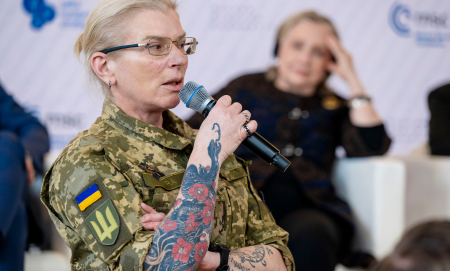
Khrystyna Boychuk, Officer, National Guard of Ukraine, asked for a moment of silence to honor those that have lost their lives as a result of the Russian war against Ukraine. She said, “It is important for me and soldiers from the frontline to be here and see that the world continues to support us. I have three important words to say. Death – the best of us have fallen for our shared right to a free life, we can preserve their memories. War – during battles I realized what change I needed to undergo to protect my unit. You must change to win wars. Life – while carrying out a mission my colleague died. Three months after he died his daughter was born. Life is the most precious thing. We are obligated to protect it – all of us.”
Daniel Salem, Officer, Special Forces Unit: “I would like to tell you a life story. There were eight of us fighting for four hours in a trench. There was a lull in shooting. I was hungry and out of nowhere came a little boy wearing a Real Madrid t-shirt, no shoes, dirty feet. He said, “Do you want to eat?” and he came back with bread, then he asked if we wanted to drink – he gave us fresh milk. His eyes were so happy – he looked at us as if we were heroes. We were fighting 100m from his house. Five minutes after he left, tanks rolled up, and his house, with him and his family in it, was destroyed. I am certain he died. I think, “Did we do enough? Did we all do enough?” We have to stop it.”
Fareed Zakaria closed the panel with a final thought: “We heard a lot about the determination of democracies to support Ukraine. It is important to remember that democracy’s enemies always assume they will outlast democracies, but history doesn’t suggest that. Hitler thought he was creating a 1000 year Reich, it lasted 15. We might bicker and have open disagreements but we have strengths and amazing staying power. We will outlast this evil as we have so many before.”
Photos are available here
Video is available here