

Press about us
Entrepreneurs, NGOs must join forces for Ukraine’s sake
Andrew Wilson is president of the East Europe Foundation, a Kyiv-based international charitable foundation that runs social, community, and economic development programs. East Europe Foundation is a member of the Eurasia Foundation Network.
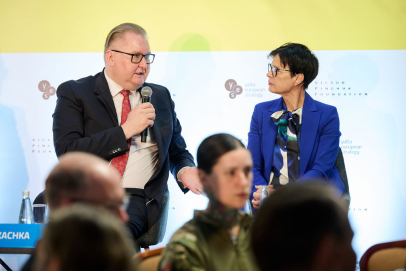
I had the pleasure of participating in the Davos Philanthropic Roundtable organized by the Victor Pinchuk Foundation at the World Economic Forum on Jan. 24. Non-profit and corporate leaders from all over the world gathered to absorb the wisdom of top philanthropists like George Soros, Tadataka Yamada of the Bill Gates Foundation, and Robert Harrison of the Clinton Global Initiative. Walter Isaacson, president of the Aspen Institute, moderated the session, which also included First Lady of Ukraine Kateryna Yushchenko.
The roundtable covered a lot of ground over a few hours, but a recurring theme was the challenge of Corporate Social Responsibility (CSR) in emerging markets. The concept of CSR regularly raises questions among corporations and economists, and observers have mixed views on the topic.
During the forum, Matthew Bishop of The Economist questioned whether corporations should engage in philanthropy at all, arguing that companies need to focus on growing their businesses before they can concentrate on ancillary social issues.
“In the developing world,” he said, “the only sustainable solution is rapid economic growth.”
Mr. Soros echoed this sentiment, stating the first responsibility of business is the bottom line. It is certainly difficult to imagine a sustainable social sector in the absence of economic development and job availability.
But as the discussion deepened, business and non-profit leaders alike recognized the increasing importance of CSR and the need to sustain philanthropic support for the non-profit sector, especially in emerging economies. Mr. Yamada argued that a growing number of young people want to work for socially responsible companies, noting that CSR is a critical success factor for many businesses. Whether corporations would otherwise choose to pursue a CSR strategy, the demands of today’s markets increasingly require companies to adopt socially responsible practices.
In many emerging economies, CSR is just starting to evolve. For nongovernmental organizations (NGOs) in these markets though, socially responsible corporations represent critical support because many international aid agencies are now reducing their presence in these emerging countries.
As Ukraine’s economy develops, many large donor organizations are turning their attention to countries with more acute development needs. The trouble with this seemingly logical shift is that many grassroots organizations in Ukraine depend on the same donors. These NGOs perform important social, health, educational, environmental, and other community services. They often perform vital work for vulnerable and underprivileged people – services that governments cannot effectively deliver.
As several speakers at the Davos Philanthropic Roundtable noted, the NGO sector cannot survive on its own. In developed countries, NGOs receive a great deal of support from philanthropists and corporations. As Mr. Bishop pointed out, corporations have something the non-profits need – capital; and non-profits have something that corporations need – public trust. And in this most critical phase of development, Ukraine must find a way to bridge the gap and build the same strong links that are developing so productively between businesses and NGOs in the developed world.
The work Mr. Pinchuk and his foundation are doing to raise awareness about the importance of philanthropy and corporate social responsibility is setting a fine example for the philanthropic community of Ukraine. His companies and other companies have made great strides in building public understanding of the importance of CSR and philanthropic giving.
Multinational and domestic corporations are supporting a number of NGO initiatives in the country, helping to sustain the good work of the non-profit sector. But the corporate community needs to do more to ensure the long term viability of the non-profit sector.
Even in developed countries, most NGOs depend on grants and donations in order to cover their operating expenses and sustain their programs. In the United States, for example, the non-profit sector accounts for more than 9 percent of all economic activity, according to Lawrence J. Friedman in Charity, Philanthropy, and Civility in American History.
While the US government finances a great deal of this activity, corporations, philanthropic organizations and individuals provide an increasing share of the support going to NGOs. Corporations should not be expected to take on all of Ukraine’s social needs, of course. And NGOs must give companies a reason to support them, by working in a transparent fashion, by engaging in effective management practices, and by producing measurable results. The government must play its part, too, by helping to create an attractive environment for corporations to develop more and deeper partnerships with the non-profit sector.
Mrs. Yushchenko, Mr. Harrison, and Judith Rosin, president of the Rockefeller Foundation, all underscored the importance of tripartite cooperation among governments, businesses, and NGOs during the discussions in Davos. Indeed history has shown that when governments provide even modest tax incentives to encourage philanthropy, corporations respond with tremendous largesse.
In Ukraine, rapid economic expansion has created an exciting philanthropic movement that could achieve enormous social successes, if the government could provide a bit more stimulus and allow companies to deduct more of their charitable contributions. Without actively responsible businesses and a supportive government, the NGO sector will not achieve its great potential for positive change in Ukraine.
And as Mrs. Yushchenko noted in her concluding
remarks, “Unless you have a vibrant NGO sector, philanthropy will not
be sustainable.”