

Press about us
‘We make arts, not ants’
A low-key awards ceremony for the Pinchuk Centre’s third international Future Generation Prize took place in a calm, snow-sprinkled, Christmassy Kiev on 6 December.
Twenty short-listed artists (all aged under 35) were among the 80 mainly youthful, unpretentiously clad guests who gathered on the Pinchuk Centre’s top floor, whose all-white lounge bar resembles a Cubist space-ship.
Victor Pinchuk, in an open-necked shirt and dark suit with a Ukrainian Flag lapel-badge, glided among the stand-up crowd with his discreet entourage of minders (one clutching a large leather bag as if the nation’s fate depended on it) and chatted enthusiastically to artists.
A EuroPop DJ played Sade’s “Smooth Operator”. Waiters in white aprons, black shirts and white bow-ties circulated with trays of champagne with raspberries and glasses of billowing dry ice.
The gilt-lettered-envelope-opening awards ceremony took place in the adjacent conference room. It was standing room only as the Pinchuk’s communications chief Dennis Kazvan compèred in faultless English, flanked on the rostrum by the jury-members including Jan Fabre, in a Göring-style overcoat, and the Ullens Centre’s Philip Tinari, in a loud-checked “Hi-de-Hi” suit.
The room buzzed as special prizes were announced for three artists: two from Ukraine, one from Russia. Nikita Kadan was chosen for a Kabakov-like installation; Zhanna Kadyrova for four panoramic photographs of Kiev dashed with explosion-like splashes; and Aslan Gaisumov for a video about his native Gozny which, explained the jury unforgettably, “add another valence to a dialectic between memory and reality”.
It looked like Ukraine 2 Russia 1, but Gaisumov (at 23, the youngest artist on the short-list) was having none of it. “I’m not Russian,” he stressed. “I’m from Chechnya.”
These choices were “very provocative but, for me, deserved”, commented Victor Pinchuk, insisting that “it would destroy the Prize’s reputation if decisions were politically motivated”.
Pinchuk now moved forward from halfway back in the room to deliver an eloquent speech. “I believe contemporary art is linked to freedom and openness,” he began. “I see Kiev again becoming a strong centre of energy for positive change!”
This was in stark contrast to the situation in Donetsk, he felt, where a contemporary art centre had been turned into a prison.
“Repressive regimes hate contemporary art,” he continued. “They fear it. They forbid it. They want to control, whereas contemporary art liberates. They want robots, they want ants. At the Pinchuk Centre we make arts, not ants. Contemporary art is the nightmare of every control-freak. Artists feel faster and deeper than other people. They are our allies in creating an exterritorial space of complete freedom.”
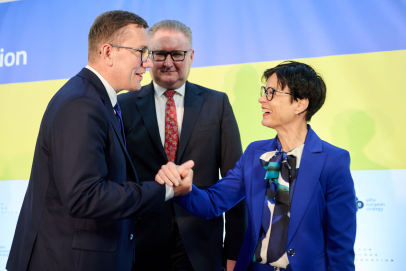
The prize’s first-ever joint-winners were announced (see below), with Colombia’s Carlos Motta delivering some suitably anti-Putinesque comments about gay repression. Then the shortlisted artists joined the Pinchuk staff for an end-of-school photograph, the whimsical DJ struck up “Tainted Love”, and the party—now fuelled by vodka and skewered hors-d’oeuvres—resumed full swing.
The winners
With the six-person jury split three-to-three, the third Pinchuk Future Generation Prize was shared between the multimedia artists Nástio Mosquito from Angola and Carlos Motta from Colombia. Both their projects touched on protest and colonial history. Each artist gets $30,000 in cash and $20,000 to produce new works.
Motta (born 1978), who left his native Bogota for New York when he was 18, was selected for his Nefandus video trilogy, shown alongside photographs, drawings based on pre-Colombian homoerotic scenes, and a large sculpted penis. The jury praised him for “using the language of a historical museum display and fabricating cultural material,” and for extending his “discourse to the local context” by producing a broadsheet entitled “Brief History of Homosexual Repression in Ukraine”.
Mosquito (born 1981), who is blessed with a sonorous voice and gift for comic irony, was represented by the video Let Me Kiss Your Butt Cheek!It starred himself, with the audience asked to watch on cushions featuring his portrait. The Jury remarked on his “seemingly playful performativity” and “adept sense of spatial dynamics”.
Both artists will be granted solo shows at the Pinchuk in 2015. “As a relentless Christian, I thank God,” Mosquito declared on hearing the news.