

Press about us
Victor Pinchuk Uses Art to Shift Attitudes in Ukraine Read more: Victor Pinchuk Uses Art to Shift Attitudes in Ukraine
Victor Pinchuk, the Ukrainian billionaire, has no qualms with offending the guests of his private museum, the Pinchuk Arts Centre, in the heart of Kiev. At times he seems intent on it. A few years ago, when the museum held its annual exhibition of young artists under 35, one of the installations involved rotting trash strewn about the floor of the exhibition space, whose walls were covered with crude snapshots of naked and bedraggled women. “It smelled so bad people had to cover their faces when they got close to it,” says Pinchuk’s spokesman, Dennis Kazvan, with an impish smile.
This year’s exhibition, which opened on Friday, took another swing at the sensibilities of some of its patrons. Anatoliy Belov, a waif-like filmmaker with a brush mustache, put on a video installation called Sex, Medicamentary, Rock’n'roll, which ended with a scene of two young men making out in a forest. By the standards of the international art scene, it was fairly tame. “But it would never be allowed in Russia,” Kazvan declared. And that seemed to be the point.
Earlier this year, Russian President Vladimir Putin signed a law against “homosexual propaganda”, which would give the work a fair chance of being banned in Russia, along with the rest of the exhibition. But by displaying it in Kiev — at one of the premier art expos of Eastern Europe — the Pinchuk Arts Centre sought to demonstrate that Ukraine is not like Russia anymore. Ukraine is, or strives to be, a part of Europe.
It was a timely gesture. At the end of this month, Ukraine is due to sign an Association Agreement with the European Union, which will cement its political and economic ties with Europe while formalizing its turn away from Moscow. For months, Putin has been fuming for over the agreement, holding several rounds of talks with his Ukrainian counterpart, Viktor Yanukovych, to convince him to join a customs and trade union with Russia instead. In August, after Yanukovych rebuffed another one of Putin’s overtures, Russia even blocked all Ukrainian goods coming across the border, demonstrating the kinds of sanctions Russia can use to punish Ukraine for its disloyalty. But it hasn’t worked. Kiev still seems intent on going ahead with the deal.
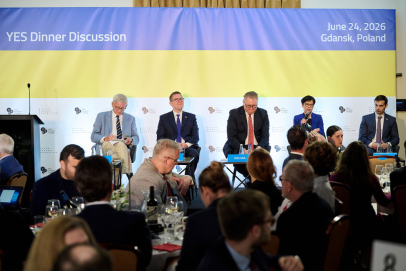
For Pinchuk, that would be a vindication. He has spent a large chunk of his $4 billion fortune trying to push his country westward. For the past 10 years, he has hosted an international summit in the Ukrainian resort of Yalta, bringing together western and local policy makers to discuss Ukraine’s integration with Europe. Called the Yalta European Strategy summit, or YES, the conference has attracted some illustrious guests over the years, including former Secretary of State Condoleezza Rice and former Speaker of the House Newt Gingrich, along with many statesman from the EU.
In Ukraine’s political elite, these European ambitions seem to have taken hold. Even Yanukovych, who was seen as a Russian stooge when he was elected President in 2010, has stayed committed to his country’s budding partnership with the EU. But westernizing the electorate has proven to be more difficult. A survey conducted last month by Deutsche Welle found that only half of Ukrainians support the agreement with the EU, while a third of the respondents rejected it outright. Many voters in the eastern half of Ukraine are still nostalgic for their Soviet brotherhood with Russia, whose language, culture and politics they still tend to emulate.
The stated goal of the Pinchuk Art Centre is to dislodge that mentality. “Victor almost has a fetish with this idea that contemporary art can change people’s thinking,” says his German assistant, Thomas Weihe. “You put a work of contemporary art in front of them, and it shakes them up.” That strategy seemed to have mixed results at the exhibition on Friday. When the young men in Belov’s film began kissing, many of the viewers groaned in disgust. Others turned and walked out of the room. “It’s a process,” Belov says after the screening. “People have to get used to it.”